In 2026, the modern American household looks fundamentally different from what it was just a few years ago. The average home is no longer built around a single internet-connected computer and a few smartphones. Instead, it is an interconnected ecosystem of smart TVs, 4K and 8K streaming devices, cloud gaming consoles, AI-powered home assistants, security cameras, smart thermostats, wearable devices, and increasingly bandwidth-hungry work-from-home setups.
Against this backdrop, WiFi has evolved from a background utility into a critical infrastructure layer of daily life. The transition from WiFi 6 to WiFi 6E, and now to WiFi 7, has created both opportunity and confusion for consumers. Many households are asking a practical question: Do we really need WiFi 7, or is WiFi 6E still more than enough?
To answer that properly, we need to go beyond marketing claims and look at what actually matters in real-world American homes in 2026: performance under load, device density, spectrum efficiency, latency, future-proofing, and cost-to-benefit ratio.
This article breaks down WiFi 7 vs WiFi 6E in depth, and translates technical differences into practical household decisions.
The Modern U.S. Home Network in 2026: Why WiFi Matters More Than Ever
Before comparing standards, it’s important to understand what WiFi is actually supporting today.
A typical U.S. household in 2026 often includes:
- 2–6 people, each with multiple devices
- 1–3 smart TVs streaming 4K or 8K content
- Cloud gaming services (Xbox Cloud, GeForce NOW, PlayStation Remote Play)
- Remote work video conferencing (Zoom, Teams, AI-enhanced meetings)
- Smart home devices (lights, locks, sensors, cameras)
- IoT appliances (refrigerators, vacuums, ovens)
- Home security systems with continuous video upload
- NAS or cloud backup systems
In many homes, the number of connected devices easily exceeds 30–80 endpoints.
This creates a new reality: WiFi is no longer about peak speed alone. It is about:
- Simultaneous device stability
- Latency consistency
- Congestion management
- Upload performance (not just download)
- Coverage across larger homes and multi-floor layouts
This shift is where WiFi 6E and WiFi 7 differ significantly.
Understanding WiFi 6E: The First Step into the 6 GHz Era
WiFi 6E is essentially an extension of WiFi 6, with one major improvement: access to the 6 GHz frequency band.
Key Features of WiFi 6E
- Supports 2.4 GHz, 5 GHz, and 6 GHz bands
- Up to 160 MHz channel width
- Theoretical maximum speeds around 9.6 Gbps (shared across devices)
- Lower interference due to new 6 GHz spectrum
- Improved performance in dense environments
The introduction of the 6 GHz band was a major breakthrough because it dramatically reduced congestion. Unlike 2.4 GHz and 5 GHz, which are often crowded with legacy devices, 6 GHz offers clean spectrum with minimal interference.
Real-World Performance of WiFi 6E
In practical home use:
- Excellent for 4K streaming on multiple devices
- Stable for Zoom calls and remote work
- Strong performance in apartments and suburban homes
- Moderate improvement in latency-sensitive tasks
However, WiFi 6E still has limitations:
- It relies on single-channel transmission per device
- Limited multi-device efficiency improvements compared to WiFi 7
- Performance drops under extremely heavy simultaneous load
- Range on 6 GHz is shorter than 5 GHz
For most households upgrading from WiFi 5 or early WiFi 6 routers, WiFi 6E still feels like a major leap.
WiFi 7: The Next Generation of High-Efficiency Networking
WiFi 7 (IEEE 802.11be), often marketed as “Extremely High Throughput,” is not just about faster speeds—it is about fundamentally changing how WiFi handles multiple devices simultaneously.
Key Features of WiFi 7
- Supports 2.4 GHz, 5 GHz, and 6 GHz bands
- Channel width up to 320 MHz (double WiFi 6E)
- Multi-Link Operation (MLO)
- 4K-QAM modulation for higher data density
- Extremely low latency design improvements
- Theoretical speeds up to 46 Gbps
While these numbers may seem abstract, the real breakthrough lies in Multi-Link Operation.
The Game Changer: Multi-Link Operation (MLO)
MLO allows devices to transmit and receive data across multiple frequency bands simultaneously.
In WiFi 6E:
- A device connects to one band at a time (2.4, 5, or 6 GHz)
In WiFi 7:
- A device can use multiple bands at once
- Traffic is dynamically distributed across channels
- Latency is reduced through parallel transmission paths
What This Means in Real Homes
Imagine a household where:
- Someone is streaming 8K video in the living room
- Another person is in a video call upstairs
- A child is gaming online
- Security cameras are uploading footage
WiFi 6E handles this sequentially within a shared spectrum environment.
WiFi 7 handles it in parallel.
This is why WiFi 7 is often described not just as faster—but “smarter under load.”
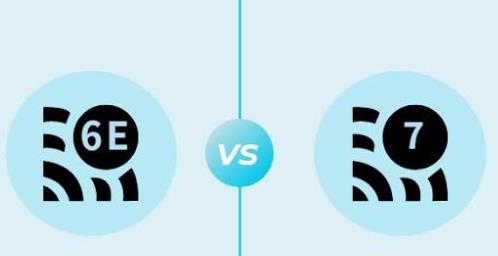
WiFi 6E vs WiFi 7: Technical Comparison (Simplified)
Here is a practical breakdown:
Speed
- WiFi 6E: Up to ~9.6 Gbps theoretical
- WiFi 7: Up to ~46 Gbps theoretical
In real-world use:
- WiFi 6E: 1–2 Gbps typical peak (good setup)
- WiFi 7: 2–5+ Gbps potential in optimized environments
Latency
- WiFi 6E: Low, but variable under load
- WiFi 7: Significantly lower and more stable
This matters for:
- Cloud gaming
- VR/AR applications
- Real-time video collaboration
Device Congestion Handling
- WiFi 6E: Good improvement over WiFi 6
- WiFi 7: Major leap due to MLO
Spectrum Efficiency
- WiFi 6E: Single-link per device
- WiFi 7: Multi-link parallel usage
Coverage
- Similar baseline range
- WiFi 7 improves effective coverage under load due to smarter routing
Real-World Scenarios: Which One Do You Actually Need?
Now we move away from specs and into practical household use cases.
Scenario 1: Small Apartment (1–2 People, Light Smart Devices)
Typical usage:
- Streaming Netflix or YouTube
- Occasional Zoom calls
- 10–20 smart devices
Recommendation: WiFi 6E is more than enough
WiFi 7 offers minimal real benefit here. The bottleneck is usually internet plan speed, not WiFi capacity.
Scenario 2: Family Home (3–5 People, Heavy Streaming)
Typical usage:
- Multiple 4K TVs
- Remote work + video conferencing
- Smart home ecosystem
- Gaming consoles
Recommendation: WiFi 6E is sufficient, WiFi 7 is optional
WiFi 6E already eliminates most congestion issues. WiFi 7 adds smoother multitasking, but not essential unless usage is heavy.
Scenario 3: Tech-Heavy Smart Home
Typical usage:
- 50–100+ IoT devices
- Security cameras streaming 24/7
- Cloud backups and NAS usage
- Multiple simultaneous 4K/8K streams
- Cloud gaming and VR
Recommendation: WiFi 7 strongly recommended
This is where WiFi 7’s Multi-Link Operation becomes critical. It prevents network bottlenecks and improves stability under constant load.
Scenario 4: Power Users and Early Adopters
Typical usage:
- 8K video editing uploads
- Remote cloud workstation access
- VR/AR development
- High-speed NAS workflows
Recommendation: WiFi 7 is the only future-proof option
WiFi 6E becomes limiting under sustained high throughput demands.
The Hidden Factor: Internet Plan vs WiFi Standard
A major misconception in 2026 is that upgrading WiFi automatically increases internet speed.
In reality:
- WiFi = internal home network performance
- ISP plan = external bandwidth
If your ISP provides:
- 300–500 Mbps → WiFi 6E is sufficient
- 1 Gbps → WiFi 6E or WiFi 7 both fine
- 2 Gbps+ → WiFi 7 becomes more relevant
Without a high-speed fiber or multi-gig plan, WiFi 7 benefits are often underutilized.
Device Compatibility Reality Check
WiFi 7 in 2026 is still in a transitional phase.
Many devices:
- Still support WiFi 6 or 6E only
- Do not yet support MLO
- Cannot fully utilize WiFi 7 capabilities
This means:
Even with a WiFi 7 router, benefits are incremental unless your ecosystem is modern.
However, backward compatibility ensures future-proofing.
Cost vs Value in 2026
WiFi 6E:
- More affordable
- Mature hardware ecosystem
- Stable performance
- Best value for most households
WiFi 7:
- Higher cost premium
- Still evolving device ecosystem
- Significant performance headroom
- Best for long-term investment
In many cases, WiFi 7 is not about immediate necessity—it is about avoiding another upgrade cycle in 2–3 years.
Security and Network Management Improvements
Both WiFi 6E and WiFi 7 support modern security protocols like WPA3, but WiFi 7 routers often integrate:
- AI-based traffic optimization
- Smarter QoS (Quality of Service)
- Automatic band steering improvements
- Better mesh networking coordination
This is increasingly relevant as homes adopt more mesh systems rather than single routers.
Mesh Networking: Where WiFi 7 Starts to Shine
Modern U.S. homes often use mesh WiFi systems.
WiFi 7 improves mesh performance by:
- Allowing faster node-to-node communication
- Reducing backhaul congestion
- Improving roaming between access points
WiFi 6E mesh systems already perform well, but WiFi 7 enhances stability in larger homes.
The Future Outlook: 2026–2030
Looking ahead, several trends will shape WiFi adoption:
- 8K streaming becomes mainstream
- Cloud gaming replaces local consoles for many users
- AI devices continuously exchange data
- Smart homes become fully automated ecosystems
- AR glasses and wearable computing increase latency sensitivity
In this context, WiFi 7 is not overkill—it is foundational infrastructure for the next digital cycle.
WiFi 6E will remain relevant, but increasingly positioned as “good enough” rather than “optimal.”
Final Verdict: WiFi 7 vs WiFi 6E in 2026
The decision comes down to household type:
WiFi 6E is best for:
- Most average U.S. households
- Budget-conscious upgrades
- Apartments and mid-sized homes
- Users with sub-1 Gbps internet plans
WiFi 7 is best for:
- Heavy multi-device smart homes
- Power users and gamers
- Multi-gig internet households
- Future-proofing beyond 2026
The simplest way to think about it:
WiFi 6E = “Everything works smoothly today”
WiFi 7 = “Everything keeps working smoothly even when demand explodes”
The transition from WiFi 6E to WiFi 7 is not just a speed upgrade—it is a structural shift in how wireless networks manage complexity. While WiFi 6E solved the problem of spectrum congestion, WiFi 7 addresses the next challenge: simultaneous, high-intensity device usage across an increasingly digital household.
For most American homes in 2026, WiFi 6E remains a highly capable and cost-effective solution. However, for households that are already operating at the edge of network demand—or those planning for the next five years of smart home expansion—WiFi 7 represents a meaningful and forward-looking investment.
In the end, the “right” choice is less about technology hype and more about understanding how deeply your home depends on connectivity today—and how much more it will depend on it tomorrow.